
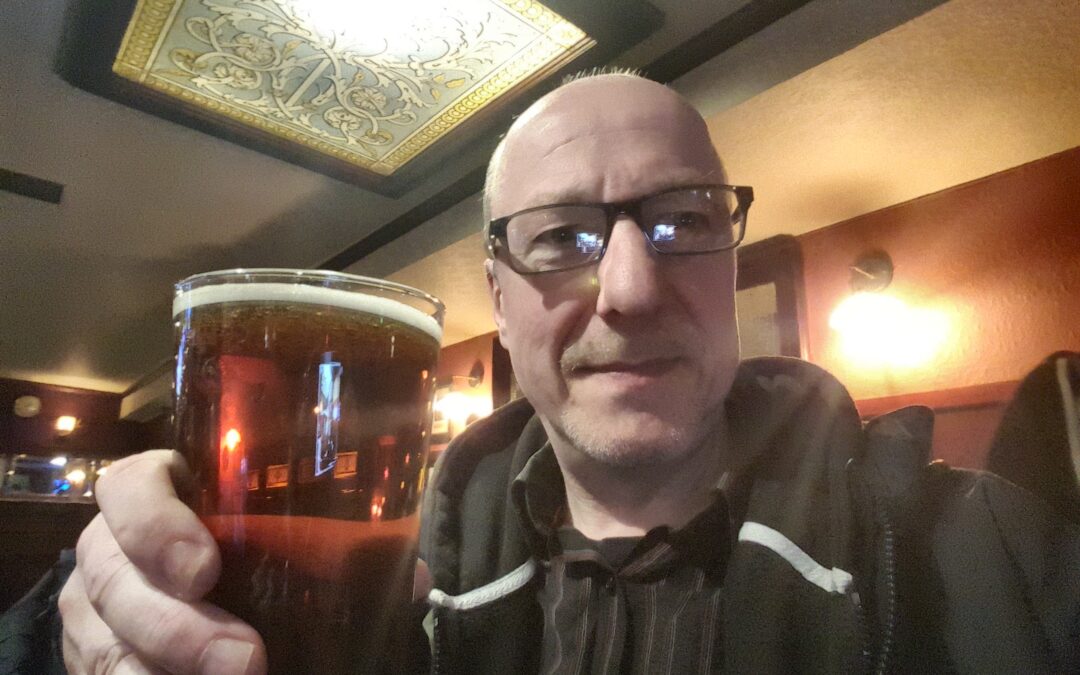
A Pint With the Other Side
The pub still works. Social media doesn't.
Social media makes agreeing to disagree look impossible. Real life doesn't.
Read the full blog post below.
 Most of us can do something that looks impossible on social media. We can sit across from someone who votes differently, talk about the state of the country, the weather, or nothing much at all, and still leave as friends. I've done it for years behind the bar and in the pub after. Plenty of you have too. It's not a rare superpower. It's ordinary life.
The trouble is that ordinary life is getting harder to see. New research from More in Common and University College London puts numbers on what a lot of us already feel. According to the research, nearly two-thirds of Britons (63%) say it is important that we can discuss every topic, no matter how strongly we disagree. At the same time, 58% say it is becoming harder to disagree than it was a few years ago. Two-thirds (67%) say the country feels divided. Seven in ten (69%) are at least sometimes reluctant to say what they really think. And 44% at least sometimes worry about being labelled, racist, right-wing, woke, or whatever the current label is.
That's the issue. We still believe disagreement is normal and necessary. We just don't trust the room any more.
And it isn't a simple left-right thing. Majorities of voters across every major party say disagreement is getting harder. And, the generational gap is wider than the political one. 74% of 65 to 74 year olds say it's harder to disagree, against 45% of 25 to 34 year olds.
That figure landed with me. I'm nearly 63, so I can remember a time before social media, when disagreeing was normal and expected, and mostly cordial, even if it got heated now and then. I could have a serious conversation in the pub, over a pint or two, and never even think about becoming disrespectful or losing a friend over it. Of course those things did happen between people sometimes. That's real life too. For the most part, though, it was kept reasonable.
Agreeing to disagree is not the same as switching your brain off
For me, disagreeing still means thinking critically about what's being said. Listening helps us do that. You should be able to hear someone out, test what they're saying, point out a weak spot, and still buy the next round if the conversation calls for it.
The research backs that up. Only 4% of people say the most important thing in a political argument is to change the other person's mind. It's telling though, that less than a third (32%) say the goal is to understand the other person's point of view. Despite that, listening comes top of the skills people value (46%), ahead of staying calm (39%), using facts (35%) or being polite (26%). And 91% say it is often good to "agree to disagree" if it ends the argument.
None of that means every claim has equal value. It means you can challenge a claim without falling out over it. That's the skill most of us already use offline.
The pub still works. Social media doesn't.
The same report found that slightly more people say they argue about politics in the pub (23%) than with strangers on social media (22%), at college, university or school (18%), or at a community group or town hall meeting (17%). The pub is also one of the few places tested that often draws people from left and right in roughly similar measure, although I would add, that also depends on local political demographics.
Social media, by contrast, is where a small and unrepresentative slice of the country does most of the loud arguing. Only 22% say they sometimes or often debate politics online, and that group is disproportionately left-leaning, university-educated and male. Most people in the study (63%) say they never debate politics online at all.
One focus-group participant put it plainly: "Social media is the most unhealthy… the arguments are really terrible on social media." Another described the fear of labels: "Everyone is afraid of being called far right or racist… so I think everyone tiptoes around." That's not unique to one side. The same dynamic shows up when other labels are in play.
Ever since social media took off, especially with Facebook and Twitter, platforms built to encourage engagement have amplified a lot of unnecessary rage and hate. At the same time, politics has become more divided and more extreme in both directions. It isn't only a left or right shift. If you think of the Overton window, the vertical line matters too, between more control and more freedom. To my eye, the left has often grown more comfortable with limits on speech, through cancel culture and laws that affect free expression. The right has made a louder cause of free speech, sometimes to the point of absolutism, and you hear that especially clearly on X. In practice, though, neither side is as consistent as it likes to claim. Both tend to defend the speech they agree with and tighten up when it's speech they don't. How you see all that usually depends on your own view, and on whose speech is being shut down.
Social media is not real life. Yet. The danger is the slow spill over. Habits that start as performance, assuming the worst motive, treating disagreement as moral failure, and the algorithm rewarding rage bait, can shape what people expect when they meet offline. That doesn't mean every street argument is caused by a feed. It does mean we need to look at how the platforms work, rather than pretend that what happens there stays there.
What we already know how to do
Britons want better skills, better spaces, and better standards from the people who set the tone. Listening is the skill they name first. And in person beats digital. Asked how they'd settle a disagreement with a colleague, 47% say face to face, and the next most popular answer (22%) is to avoid it altogether. And 83% say politicians should always be respectful when they disagree. But, 57% of respondents say politicians tend to be rude and disrespectful when they debate each other.
None of that is revolutionary. It's closer to what a decent pub conversation already looks like: say your piece, listen to the reply, test the claim, keep the person separate from the opinion, and leave the door open for next time. Critical thinking stays in the mix. You can disagree without forgetting there's another person in front of you.
If the solution has to tackle the social media problem, it probably starts with treating the offline habit as the real one and the online version as the distorted one, not the other way round. It begins by remembering that social media is not real life! The numbers suggest most people already see it that way. They just need the room to practise it without the labels waiting outside.
Over to you!
Where do you still manage to disagree offline? Would that be harder, or impossible, in the same way online? Watch or listen to the full episode above, check the numbers for yourself, and tell me in the comments.
Sources and further reading
More in Common – Disagreeing Well (September 2026): https://www.moreincommon.org.uk/research/disagreeing-well/
Caveat: The research is based on polling of around 2,000 people plus focus groups. It captures what people say they think and do, not observed long-term behaviour.
Related Episodes
Polarized Opinions
It seems that everything that’s happening now and has over the last many years has been somehow designed to increase polarization in the world.

New Age Deception
There’s so much contradicting information out there, it’s difficult to know what to believe v what to dismiss. Threads of truth within a mire of disinformation. Genuine channellings v MK Ultra. Spiritual info v pacification.